The First Video Game in History: Origins, Creation, and Evolution
Discover the fascinating history of the first video game in history. Explore the origins, creation, and legacy of early pioneers like Tennis for Two and Spacewar!
Today, the gaming industry is a multi-billion dollar behemoth, offering photorealistic graphics, massive open worlds, and deeply immersive virtual reality experiences. However, long before the era of powerful home consoles and high-end gaming PCs, the concept of digital entertainment had to be built from the ground up by physicists and computer scientists. Determining the absolute first video game in history is a topic of ongoing debate among historians, as it largely depends on how one defines the term “video game.”
Was it the first electronic interactive display? The first game played on a computer monitor? Or the first digital system created purely for the sake of entertainment? To understand the birth of this monumental industry, we must travel back to the mid-20th century, exploring the academic laboratories where giant mainframes and oscilloscopes gave birth to digital play.
The Early Contenders: Radar Displays and Academic Experiments
If we look at the earliest known interactive electronic game, the timeline points to 1947. Thomas T. Goldsmith Jr. and Estle Ray Mann patented the “Cathode-Ray Tube Amusement Device.” Inspired by World War II radar displays, this device allowed players to turn knobs to adjust the trajectory of a light beam on a screen to simulate firing missiles at targets. However, because it lacked any digital computing power or memory and used screen overlays instead of generated graphics, many historians hesitate to call it a true video game.
Moving into the early 1950s, games were primarily used as academic demonstrations to showcase the power of massive, room-sized computers. In 1952, Alexander S. Douglas created OXO, a digital version of tic-tac-toe, to demonstrate his thesis on human-computer interaction at the University of Cambridge. Played on the EDSAC computer, a player used a rotary telephone dial to input their moves against an artificial intelligence. While OXO featured a digital display, it was essentially an academic tool rather than an entertainment product meant for the general public.
Tennis for Two (1958): The True Pioneer of Entertainment
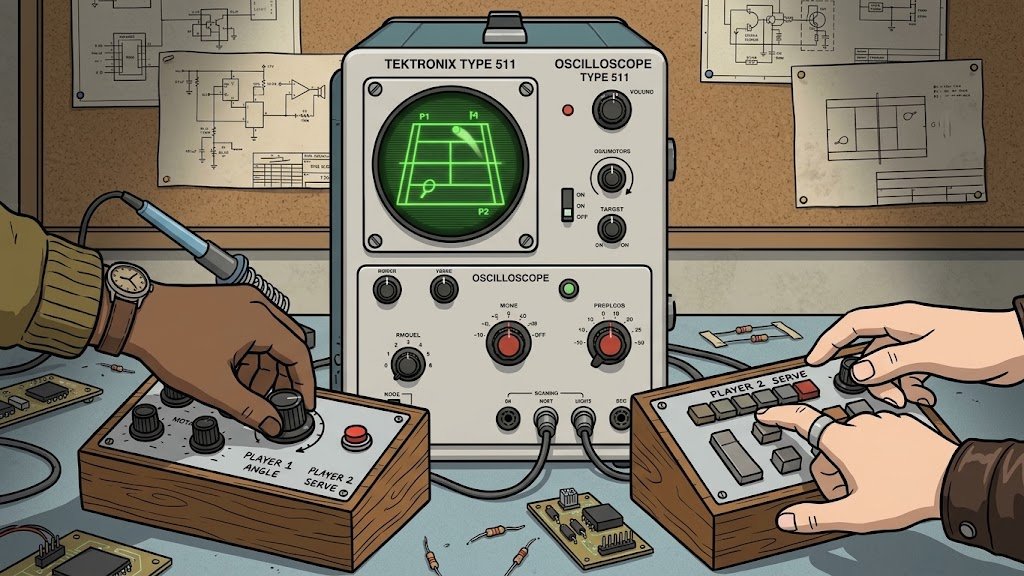
When searching for the first video game in history created strictly for entertainment, most historians point to Tennis for Two. Created in 1958 by American physicist William Higinbotham, this game was designed for a very specific purpose: to cure the boredom of visitors attending the annual public exhibition at the Brookhaven National Laboratory in New York.
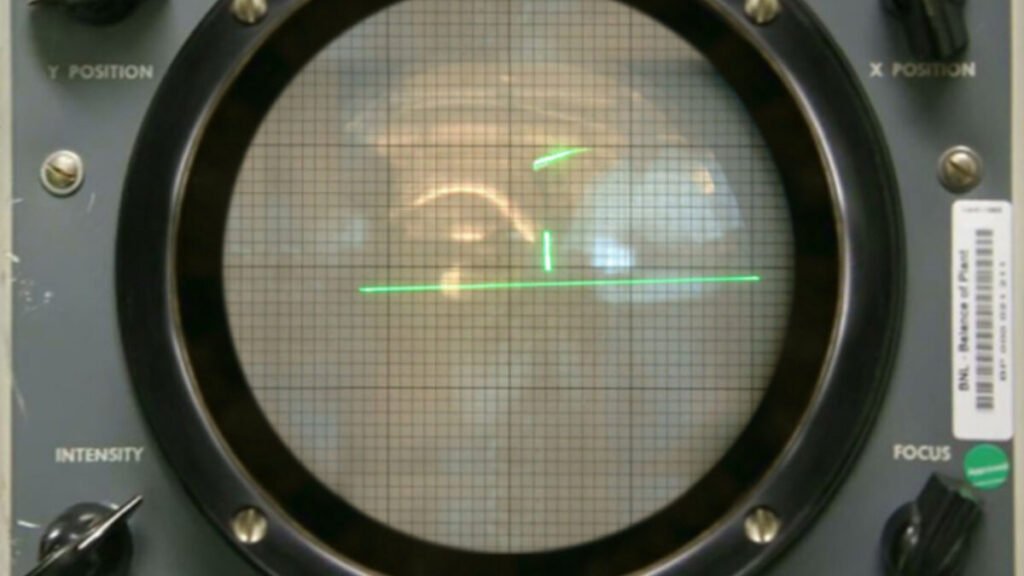
Higinbotham, who had previously worked on radar systems and the Manhattan Project, noticed that the scientific exhibits were incredibly dry and static. He wanted to create something interactive and fun. Using a Donner Model 30 analog computer, he hooked up a 5-inch oscilloscope screen and designed a rudimentary game of tennis.
The mechanics of Tennis for Two were remarkably advanced for their time. The display showed a side view of a tennis court with a line representing the ground and a short vertical line representing the net. Players used two custom-built aluminum controllers—each equipped with a knob to adjust the angle of the return and a button to hit the ball. The game even calculated simulated gravity and wind resistance, making the ball bounce realistically over the net.
The response was overwhelming. Hundreds of high school students and visitors lined up for hours just to play a few rounds. Despite its massive success, Higinbotham did not patent the game, viewing it merely as a temporary exhibit rather than a revolutionary invention. The system was dismantled shortly after to use its parts for other scientific research, but its legacy as a pure entertainment product remains undisputed.
Spacewar! (1962): The Birth of Digital Gaming Culture
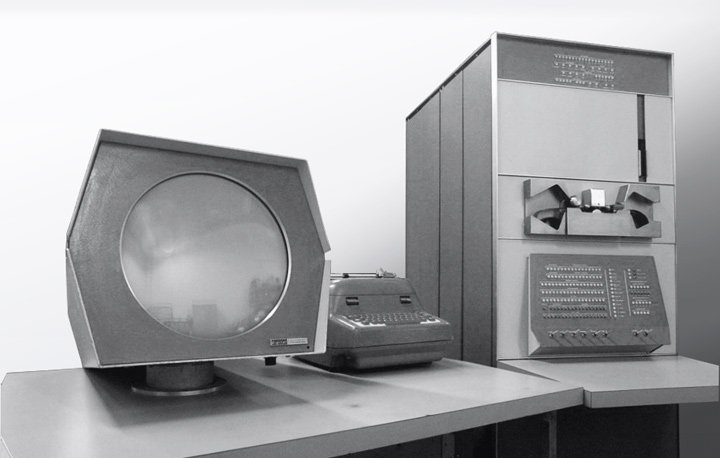
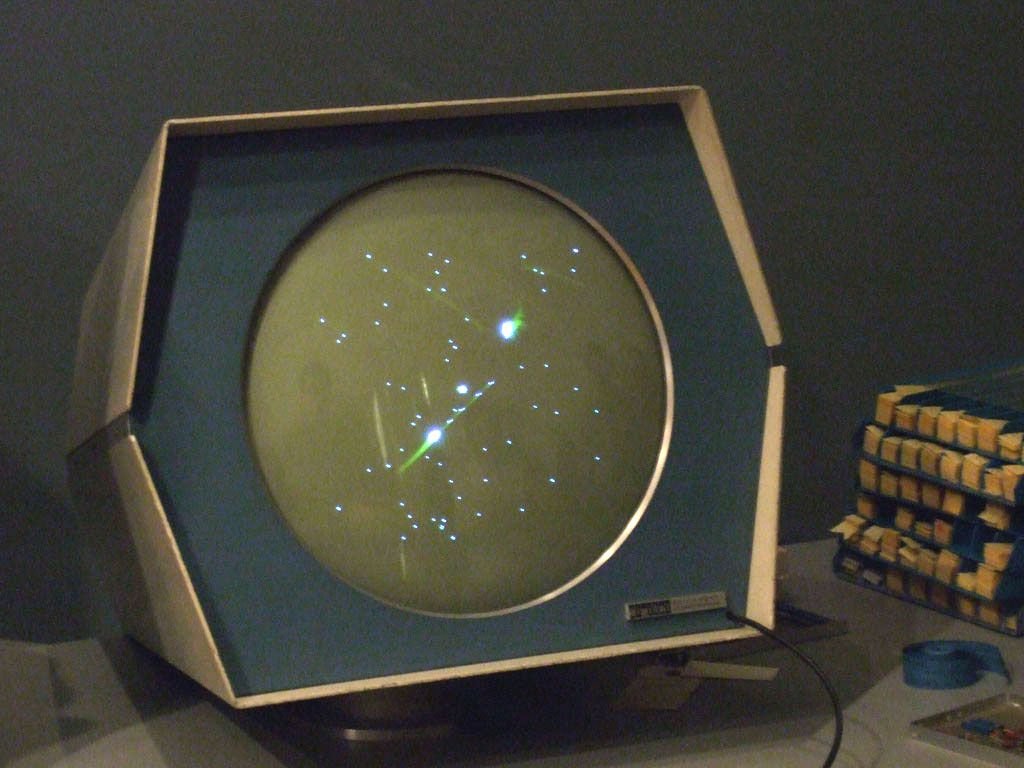
While Tennis for Two was confined to a single laboratory, the next major evolutionary step occurred at the Massachusetts Institute of Technology (MIT) in 1962. A group of students from the Tech Model Railroad Club, led by Steve Russell, got their hands on a newly installed DEC PDP-1 computer. They wanted to create a program that would push the expensive hardware to its absolute limits while being incredibly fun to use. The result was Spacewar!.
Spacewar! was a two-player game where each person controlled a spacecraft—the “Needle” and the “Wedge.” The objective was to destroy the opponent using limited torpedoes while navigating around a star in the center of the screen that exerted a gravitational pull. If a player was cornered, they could hit a “hyperspace” button as a last resort, which would teleport their ship to a random location on the screen, though at the risk of instantly exploding.
What makes Spacewar! so critical to the history of the first video game is its distribution. Unlike previous experiments, the code for Spacewar! was shared. It was copied and spread to other academic institutions and laboratories across the United States that possessed PDP-1 computers. It essentially created the very first video game community and became a major cultural touchstone for the early hacker and computer science communities.
The leaps made from the Cathode-Ray Tube Amusement Device to Spacewar! set the foundation for the commercial gaming boom that would follow a decade later. When Nolan Bushnell saw Spacewar! during his university years, it inspired him to create Computer Space and eventually found Atari, launching Pong into the mainstream in 1972. The towering achievements of modern gaming owe their existence to these humble, glowing green lines on analog oscilloscopes—a testament to human curiosity and our enduring desire to play.
“A recent hint from the Twitch CEO suggests that GTA 6 Online might not launch until 2027. Discover what this means for the massive multiplayer release timeline.”