
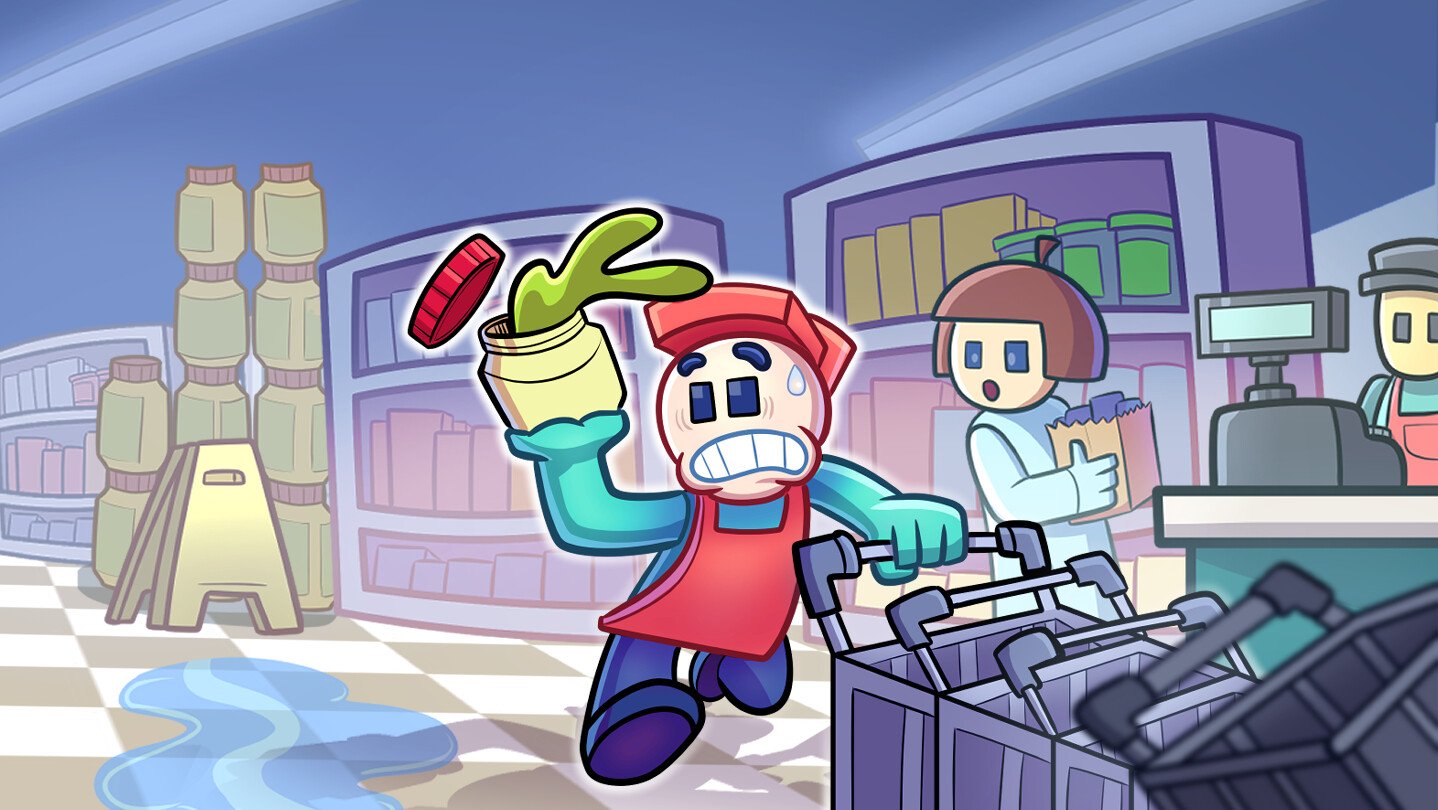
Cleanup on Aisle 3 Review: Gameplay, Release Date & Features
Read our Cleanup on Aisle 3 review covering its chaotic grocery store gameplay, core mechanics, co-op features, release date, and PC platforms.
In this Cleanup on Aisle 3 review, we look at how not every management game needs a complicated economy, endless spreadsheets, or a relaxing atmosphere to be entertaining. Sometimes, the best idea is to put one overwhelmed employee in charge of an entire grocery store and watch everything fall apart.
That’s the premise behind Cleanup on Aisle 3, an upcoming arcade management game from Aviary Interactive. Instead of offering a traditional supermarket simulation, it combines time management, physics-based interactions, score-chasing mechanics, and roguelite-style progression into a frantic retail experience. Players must keep shelves stocked, serve customers, collect shopping carts, and deal with increasingly unreasonable demands from corporate management.
The result looks closer to a chaotic shift at an understaffed supermarket than a conventional business simulator. With solo play, two-player cooperative gameplay, and a progression system built around increasingly difficult stores, the game aims to turn everyday retail tasks into a fast-paced arcade challenge.
But what exactly makes Cleanup on Aisle 3 different, and is it worth keeping on your radar? Here’s a detailed look at its gameplay, mechanics, release date, and overall potential.
Release Date, Developer, and Platforms
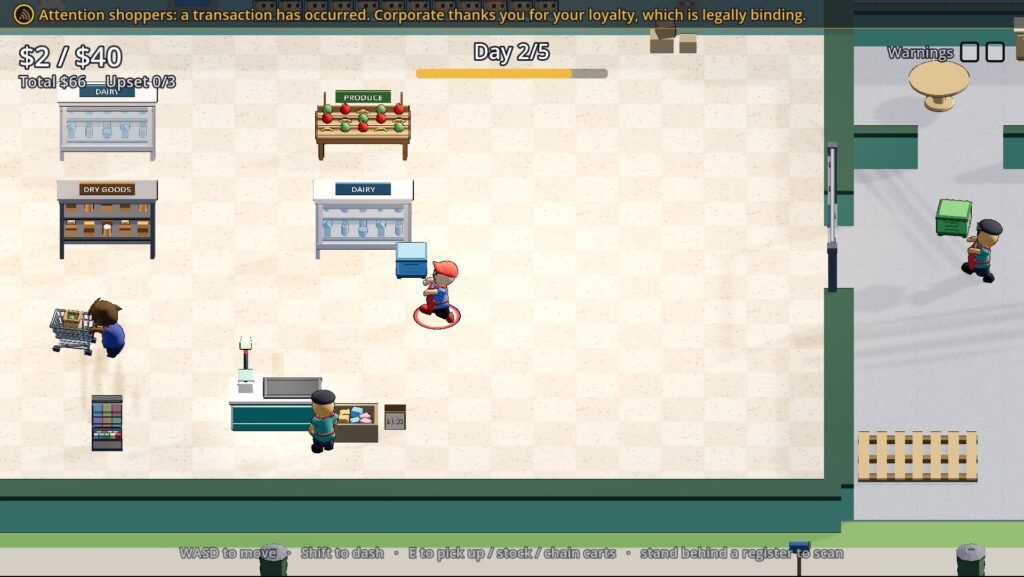
Cleanup on Aisle 3
| Release date | November 3, 2026 |
| Developer / Publisher | Aviary Interactive |
| Platforms | PC (Windows, macOS, Linux) |
| Players | Single-player and two-player co-op |
| Genres | Arcade, Simulation, Management |
| Price | Not announced |
According to its Steam listing, Cleanup on Aisle 3 is scheduled to launch on November 3, 2026. It is being developed and published by Aviary Interactive, an independent studio founded by Jim McQuillan. The game is planned for release on Steam for Windows, macOS, and Linux.
The full game has not been released yet, so this article is a preview based on the available game information, rather than a review based on a completed playthrough. Its final performance, overall balance, and long-term replay value will need to be assessed after launch.
A free demo is already available on Steam. It lets players experience the first five days at the ValuCo #3 store, and progress is designed to carry over into the full game.
You can find the game and demo on the official Steam page.
Gameplay and Core Mechanics
The main attraction of Cleanup on Aisle 3 is its combination of familiar supermarket tasks with deliberately exaggerated arcade mechanics. Rather than treating every activity as a realistic simulation, it turns stocking shelves, operating a checkout, and collecting carts into challenges that demand speed, coordination, and quick decision-making.
Stocking Shelves by Throwing Crates
One of the game’s most distinctive mechanics involves throwing delivery crates across the store. When shelves are empty, players can pick up stock and launch it toward the appropriate shelf instead of simply walking every item into position.
Successfully landing a crate restocks the shelf, while a missed throw creates another problem to deal with. This system introduces a physical, skill-based element to an otherwise ordinary management task.
It also creates an interesting risk-and-reward decision. A long throw might save valuable time, but a failed attempt can make an already chaotic shift even harder to manage.
Checkout Combos and Score Chasing
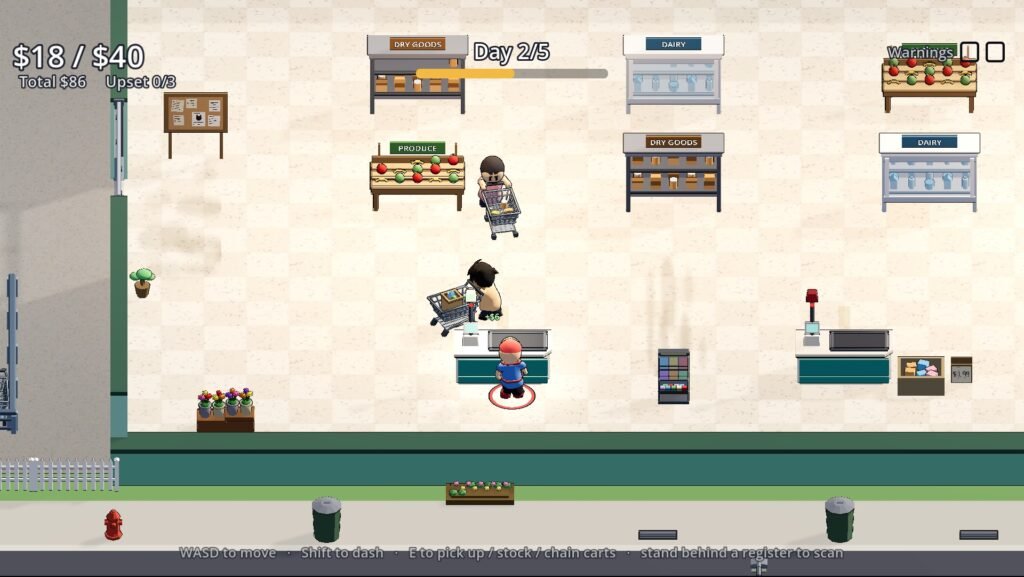
The checkout system is another important part of the gameplay. Players scan items at the register and attempt to maintain a consistent rhythm to build combos and earn tips.
This transforms an everyday retail activity into something closer to an arcade score challenge. Instead of simply processing customers, you need to maintain accuracy and speed while other responsibilities compete for your attention.
The combination of timing and multitasking should appeal to players who enjoy games where mastering a simple action becomes increasingly difficult under pressure.
Managing Shopping Cart Trains
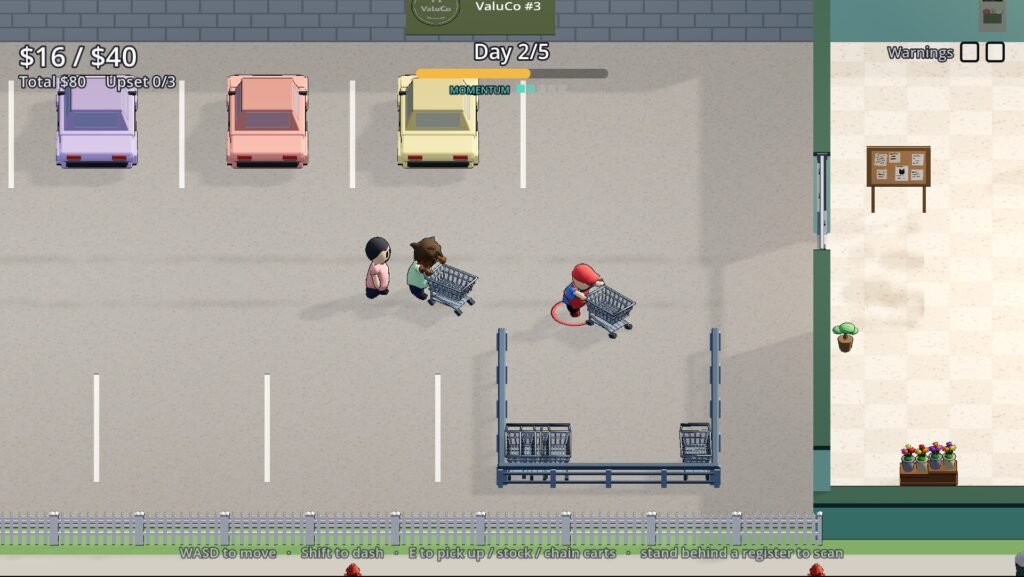
Shopping carts might seem like a minor detail in a supermarket simulation, but Cleanup on Aisle 3 gives them their own mechanic.
Players can connect up to five stray carts into a train and pull them back across the parking lot. Doing this efficiently helps keep the store running, but the distance and time involved become more demanding as the environment expands.
This is a good example of how the game takes mundane tasks and gives them a distinct arcade identity. Rather than being an activity that happens in the background, cart collection becomes another problem that needs to be solved before the next rush arrives.
Corporate Upgrades and Roguelite Progression
Perhaps the most important system is the nightly corporate directive. At the end of each day, players choose from proposed improvements that change how the store operates.
These can introduce new departments, expand the parking lot, or add systems such as self-checkout. Although these changes sound helpful, they also increase the complexity of running the business.
That creates the central tension of Cleanup on Aisle 3: progression does not necessarily make your job easier. A bigger store means more space to manage, more customer demands, and more opportunities for something to go wrong.
The game also moves players between different struggling supermarket locations, including a 24-hour store, a large Megamart, and a concept store with unusual corporate initiatives. Each location introduces its own challenges and reinforces the game’s satirical take on retail management.
Single-Player and Co-Op: Is It Better With a Friend?
Although the game can be played alone, Cleanup on Aisle 3 also supports two-player local co-op and Steam Remote Play Together.
Playing solo places every responsibility on one person. You need to manage the checkout, restock shelves, collect carts, and respond to the demands of an increasingly complicated store. This setup could appeal to players who enjoy challenging time-management games and improving their own performance through repeated attempts.
Co-op, meanwhile, offers the possibility of dividing responsibilities between two players. One person could focus on checkout combos while the other handles deliveries and carts, although the most effective division of labor will depend on the situation.
Remote Play Together is particularly useful because it allows players to share the experience remotely without both participants necessarily owning a copy. Full controller support is also listed among the game’s features.
The co-op mode could ultimately be one of the game’s strongest features. Games built around multitasking and escalating pressure often become more entertaining when players need to communicate, coordinate, and recover from each other’s mistakes.
Graphics, Presentation, and Performance Expectations
Cleanup on Aisle 3 uses a colorful, cartoon-inspired presentation that fits its exaggerated approach to retail management. Its visual identity is also unusual from a development perspective: Aviary Interactive states that the game’s art direction is generated through code, including its colors, signage, icons, and other visual elements.
That technical approach gives the project a distinctive identity and reflects the ambitions of a small independent studio. Instead of competing with large simulation games on visual realism, it focuses on clear presentation and readable gameplay.
The listed PC system requirements are relatively modest. The minimum Windows specification includes a dual-core 2.5 GHz processor, 4 GB of RAM, a Vulkan 1.1-capable graphics card with 2 GB of VRAM, and 1 GB of storage. Recommended specifications include 8 GB of RAM and a graphics card with 4 GB of VRAM.
These requirements suggest that the game is targeting accessible PC hardware. However, actual performance, loading times, and stability cannot be judged reliably until the full release is available.
Is Cleanup on Aisle 3 Worth Watching?
Cleanup on Aisle 3 has a promising concept that combines supermarket management with physics-based interactions, arcade scoring, and roguelite progression. Its strongest ideas are also its simplest: throwing crates to restock shelves, building checkout combos, and dragging shopping cart trains across a growing parking lot.
The nightly upgrade system could give repeated runs a welcome sense of progression, while the increasingly demanding stores offer opportunities to introduce new challenges. Two-player co-op adds another layer of potential, particularly for friends who enjoy chaotic management games.
There are still unanswered questions. Will the mechanics remain entertaining over longer sessions? Will the progression system offer enough variety to encourage repeated play? And will the increasing workload feel satisfyingly challenging rather than unnecessarily frustrating?
For now, Cleanup on Aisle 3 looks like a game worth keeping on your radar if you enjoy time-management challenges, physics-based arcade gameplay, and co-op experiences. Its free demo offers the best way to judge whether its particular brand of supermarket chaos is for you.
Our preliminary verdict: A promising indie management game with inventive mechanics and plenty of potential.
“Starting your adventure in Atreia can be overwhelming. From essential character progression to early-game features you shouldn’t miss, here are the 10 most crucial steps every beginner needs to take in Aion 2.”