
Sony Patent Hints DualSense Controller Could Handle Contactless Payments
A new Sony patent reveals how the PS5 DualSense controller could act as a contactless payment bridge using smartphones and physical credit cards.
When Sony released the PlayStation 5, the DualSense controller immediately stood out as one of the generation’s most impressive hardware innovations. Features like adaptive triggers, advanced haptic feedback, and a built-in microphone elevated player immersion far beyond standard gamepads. However, a newly published patent from Sony suggests that the Japanese tech giant sees even greater potential in the DualSense—one that extends well beyond traditional gameplay mechanics and into the realm of digital financial transactions.
According to the newly surfaced patent documentation, Sony is exploring a concept where the DualSense controller acts as a central hub for contactless payment processing. Instead of manually entering credit card details or saving sensitive financial information directly to your PlayStation Network account, players could simply bring their smartphone or contactless payment card close to the controller to execute transactions on their console.
How the DualSense Contactless Payment System Works
The mechanics described in the patent outline a surprisingly seamless interaction between the player’s mobile device, physical payment cards, and the PlayStation 5 console. Rather than acting as a standalone digital wallet that holds cash or payment tokens natively, the DualSense functions as a physical bridge—likely leveraging Near Field Communication (NFC) or a similar short-range wireless protocol embedded within the controller.
When a user decides to purchase a digital game, downloadable content (DLC), or in-game currency on the PlayStation Store, they would bring their smartphone near the DualSense controller. This action triggers a secure payment interface on the phone’s screen. Once the player authorizes the transaction through their phone—using biometric authentication such as Face ID, fingerprint scanning, or a mobile wallet app—the payment is processed externally. Upon confirmation, the purchased content instantly activates and becomes available for download directly on the PS5.
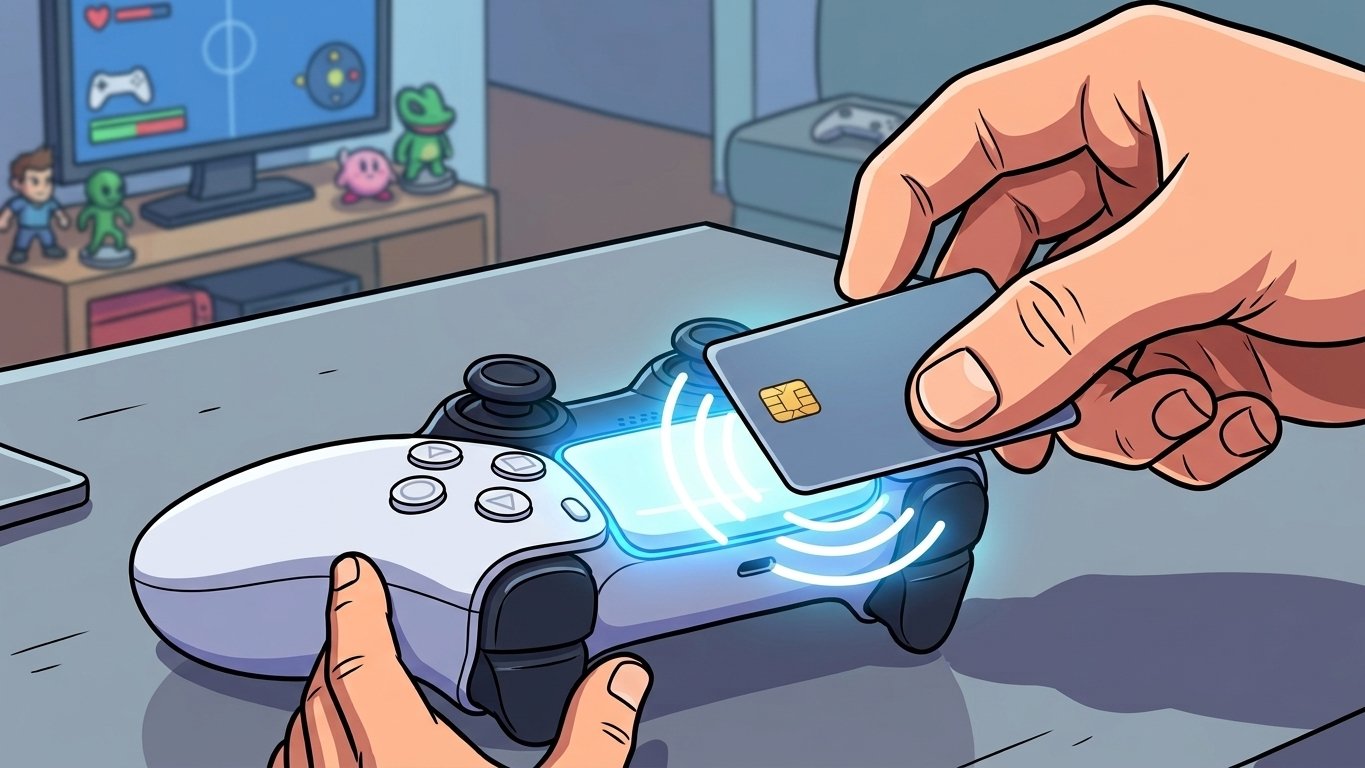
Interestingly, the patent illustrations also demonstrate a scenario where a physical contactless credit or debit card is tapped directly against the controller. In one specific example detailed in the filing, tapping a physical card against the DualSense allows players to instantly purchase digital PlayStation gift cards or wallet top-ups. This indicates that Sony’s vision for the technology is versatile, supporting multiple contactless payment methods rather than limiting users exclusively to smartphone apps.
Eliminating PSN Credit Card Hassles and Enhancing Security
This proposed payment method addresses several longstanding friction points for console gamers. Primarily, it offers a major security benefit for players who are reluctant to store their credit card details or personal bank information on network-connected gaming consoles. Data breaches and unauthorized account access remain persistent concerns in the digital age, making many users hesitant to link permanent payment methods to their online gaming profiles.
By utilizing the DualSense as a payment bridge, sensitive financial data remains isolated on the user’s personal smartphone or payment card, never actually being saved on the PlayStation Network servers. This reduces the risk of unintended purchases—such as children accidentally spending money in digital storefronts—because every transaction would require a physical secondary authorization via a smartphone or card tap.
Additionally, this feature promises a significant quality-of-life improvement regarding checkout speed and convenience. Typing long credit card numbers, billing addresses, and security codes using an on-screen console keyboard can be a tedious and frustrating experience. By routing the checkout process through established mobile payment infrastructure like Apple Pay, Google Wallet, or banking apps, Sony can streamline purchasing into a two-second gesture.
Will This DualSense Feature Actually Launch?
It is essential to maintain realistic expectations whenever analyzing tech industry patents. Tech giants like Sony routinely file hundreds of patents each year to secure intellectual property rights and protect experimental concepts developed by their engineering teams. Many of these ideas never transition from conceptual blueprints into commercial products available to the public.
Implementing this feature in real life would also depend on existing controller hardware capabilities. If current DualSense models lack the necessary NFC receiving hardware required to scan physical cards or communicate with smartphones at close range, Sony would either need to reserve this feature for future hardware revisions—such as a DualSense Pro, a revised base controller, or the next generation of PlayStation hardware—or rely on existing short-range communication protocols.
Nonetheless, this patent offers a fascinating glimpse into how Sony views the future of gaming peripherals. By attempting to transform the DualSense into a multi-functional device that bridges the gap between everyday digital tasks and console gaming, Sony continues to push the boundaries of what a gaming controller can do.
“Aspyr has announced the Middle-earth: Shadow Bundle for the Nintendo Switch 2, bringing both Shadow of Mordor and Shadow of War to Nintendo hardware for the first time. Launching on September 30, pre-orders are currently live with a special 50 percent discount.”